
Earth is full of places that can completely change our understanding of what a landscape should look like. Some locations appear to have been created by an artist, while others seem to belong to a distant planet. Strange colors, unusual rock formations, extreme environments, and rare natural processes have created destinations that are difficult to believe until you see them.
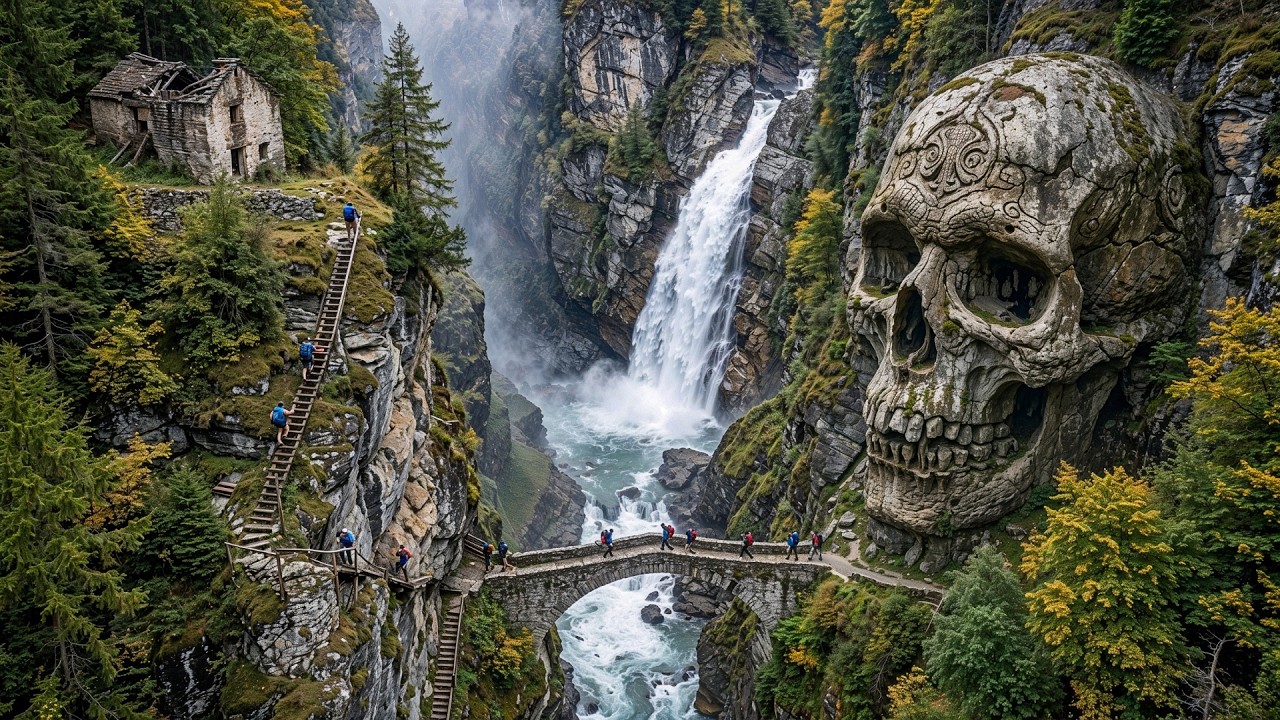
These places are not imaginary. They exist because of powerful geological forces, changing climates, unusual ecosystems, and processes that have been developing for thousands or even millions of years.
Exploring these strange locations reminds us that nature does not always follow the patterns we expect.
The Spotted Lake of Canada
In British Columbia, Canada, there is a lake that can look completely different from an ordinary body of water.
Spotted Lake is known for its numerous mineral-rich pools that appear like large spots across the surface during warmer and drier periods.
The unusual patterns are created as water evaporates and leaves behind concentrated minerals. Depending on the season, the individual pools can display different colors.
The lake contains high concentrations of minerals such as magnesium sulfate, calcium, and sodium sulfates.
For local Indigenous communities, the lake has long been recognized as a place of significance.
From a distance, its unusual surface can resemble a giant collection of colorful circles painted across the landscape.
The Salar de Uyuni Becomes a Sky on the Ground
Bolivia’s Salar de Uyuni is the largest salt flat in the world.
During dry periods, its surface appears as an enormous white plain stretching toward the horizon. The salt forms distinctive polygonal patterns across large sections of the landscape.
After rainfall, a shallow layer of water can cover the surface and create an extraordinary mirror effect.
When the water is calm, the boundary between sky and ground almost disappears.
Visitors can sometimes photograph scenes where clouds appear to continue directly beneath their feet.
The effect is completely natural and comes from the incredibly flat surface of the salt plain combined with a thin layer of water.
The Rainbow Mountains of China
In China’s Gansu Province lies the Zhangye Danxia landform, famous for its colorful mountains and dramatic geological patterns.
The mountains contain layers of red, orange, yellow, and other shades that appear in sweeping bands across the landscape.
These colors were formed by mineral-rich sedimentary layers deposited over immense periods. Geological forces later lifted and exposed the layers, while erosion shaped them into the dramatic formations seen today.
The result looks almost like an enormous painted landscape.
The mountains demonstrate how geological history can remain visible on the surface in the form of natural colors and patterns.
The Cave of the Crystals in Mexico
Deep underground in Mexico is one of the most extraordinary crystal environments ever discovered.
The Cave of the Crystals near Naica contains enormous selenite crystals that grew under highly unusual geological conditions.
Some crystals are several meters long, creating a chamber that looks more like an alien structure than a natural cave.
The crystals formed because mineral-rich groundwater remained at a stable temperature for a very long period.
The cave itself is extremely hot and humid, making direct exploration dangerous without protective equipment.
Its remarkable crystals demonstrate that even underground environments can contain structures of astonishing size.
The Salar de Atacama Has a Harsh Beauty
Chile’s Salar de Atacama is a vast salt basin surrounded by dramatic mountains and volcanoes.
The region receives very little rainfall, while evaporation is intense. Over time, minerals accumulate and form thick salt deposits across the landscape.
The surface can appear rough and textured, with bright white salt contrasting against dark mountains.
Nearby lagoons provide habitat for flamingos and other wildlife, creating an unusual combination of harsh desert conditions and living ecosystems.
The landscape also contains important mineral resources, making the region significant both scientifically and economically.
Its extreme dryness and dramatic surroundings can make visitors feel as though they have entered another world.
The Wave in Arizona
In the deserts of Arizona, The Wave is a sandstone formation famous for its smooth, flowing curves.
The rock layers display bands of red, orange, yellow, and other shades that form a pattern resembling a frozen wave.
Wind and water erosion gradually shaped the sandstone over enormous periods.
The curves are so smooth and symmetrical that photographs can make the landscape appear computer-generated.
Access to the area is limited to protect the fragile environment, making it a destination that requires careful planning.
The Wave is a powerful example of how erosion can transform ordinary rock into a landscape that looks almost impossible.
The Danakil Depression Looks Like Another World
The Danakil Depression in Ethiopia is famous for its extreme heat, salt formations, volcanic activity, and brightly colored mineral landscapes.
The region contains yellow, orange, green, and red formations created by minerals and geological processes.
Some areas contain acidic pools and hot springs, making the environment highly challenging for most forms of life.
Despite these harsh conditions, specialized microorganisms can survive in certain parts of the region.
The landscape has attracted scientific interest because some of its conditions resemble environments that could exist on other planets.
The Catacombs Beneath Paris
Beneath the streets of Paris lies a vast network of underground tunnels.
Some sections became famous as the Paris Catacombs, where the remains of millions of people were transferred from overcrowded cemeteries beginning in the late eighteenth century.
The underground passages contain long corridors lined with carefully arranged bones.
The existence of this hidden world beneath one of the world’s most famous cities is surprising by itself.
The catacombs demonstrate how modern cities can contain layers of history that remain invisible to people walking above them.
The Blue Grotto of Malta
Along the southern coast of Malta is a collection of sea caves known for brilliant blue water and dramatic rock formations.
The Blue Grotto is especially striking when sunlight enters the caves and interacts with the clear Mediterranean water.
The combination of light, water depth, and reflective rock surfaces can create intense shades of blue.
The caves were formed naturally through geological processes and continuous interaction between the sea and limestone coastline.
The result is a landscape that can look almost illuminated from within.
Nature Can Break Our Expectations
These places demonstrate that Earth is capable of producing landscapes that challenge our expectations at every level. A lake can become covered with colorful mineral pools, a salt flat can transform into a giant mirror, and ordinary sandstone can be shaped into waves.
Some places reveal ancient geological history, while others demonstrate the strange ways that life adapts to extreme environments.
The most fascinating part is that none of these landscapes require fictional explanations. They exist because Earth’s natural systems are incredibly complex.
Our planet continues to surprise us because it is still changing. Mountains rise, rocks erode, glaciers move, oceans reshape coastlines, and ecosystems adapt.
The next time a landscape seems impossible, it may simply be another reminder that nature is far more creative than we expect.