
Our planet is filled with landscapes that seem almost too strange to be real. Some places contain unusual colors, extreme environments, remarkable geological formations, or natural features that look as though they belong in a fantasy movie.
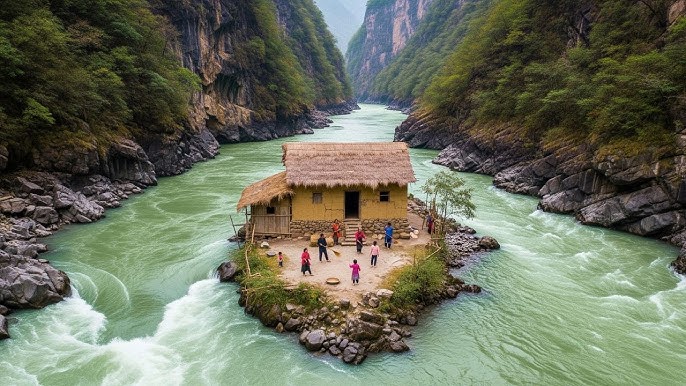
What makes these destinations even more fascinating is that they are not computer-generated scenes or imaginary worlds. They are real places shaped by natural forces, ancient geological activity, climate, water, and time.
From underground rivers to colorful mountains and remote islands, these unusual locations reveal just how diverse Earth’s landscapes can be.
Waitomo Glowworm Caves in New Zealand
Deep beneath the surface of New Zealand’s North Island lies a cave system famous for an extraordinary natural light display.
The Waitomo Glowworm Caves are home to tiny creatures that produce a blue-green glow. When visitors enter the dark caves, thousands of these glowing organisms can appear across the ceiling.
The effect resembles a star-filled night sky, even though the display is taking place underground.
The glowing creatures are the larvae of a species commonly known as the New Zealand glowworm. Their light helps them attract prey, creating delicate strands that hang from the cave ceiling.
The cave’s combination of darkness, underground formations, and natural bioluminescence creates an experience unlike almost anywhere above ground.
The Chocolate Hills of the Philippines
On the island of Bohol in the Philippines, hundreds of unusual hills rise across the landscape.
The Chocolate Hills are famous for their similar shapes and rounded profiles. During the dry season, the vegetation covering many of the hills turns brown, giving them their famous name.
The hills were formed through long geological processes involving limestone and erosion.
From a distance, the landscape can look almost artificial. Hundreds of rounded formations appear to stretch toward the horizon, creating a pattern that is difficult to imagine without seeing it.
Their unusual appearance has made the Chocolate Hills one of the most recognizable natural attractions in the Philippines.
The Rainbow Mountains of Peru
High in the Andes of Peru lies Vinicunca, commonly known as Rainbow Mountain.
The slopes contain bands of different colors, including red, yellow, green, and other shades.
The colors are produced by different minerals within the geological layers. Changes in weathering and erosion have exposed these layers, creating the striped appearance visible today.
The mountain sits at a very high elevation, making the journey challenging for visitors.
Despite its natural origin, the landscape looks almost as if someone painted broad colorful lines across the mountain.
Pamukkale in Turkey
Pamukkale is one of Turkey’s most distinctive natural landscapes.
Its white terraces contain pools of mineral-rich thermal water that flow over a series of formations.
The brilliant white appearance comes from deposits of calcium carbonate left behind as the water moves across the surface.
From a distance, the terraces can look like snow-covered hills or frozen waterfalls.
Nearby is the ancient city of Hierapolis, which developed around the thermal springs and became an important center in the ancient world.
The combination of natural beauty and ancient history makes Pamukkale particularly unusual.
Socotra Island in Yemen
Socotra is an isolated island in the Arabian Sea that is famous for its unusual plants and distinctive landscapes.
One of its most recognizable species is the dragon blood tree. Its branches spread outward in a shape that resembles a large umbrella, giving the landscape an almost prehistoric appearance.
The island’s isolation has allowed many plants and animals to evolve in unique ways. A significant number of its species are endemic, meaning they are naturally found only in that region.
The strange vegetation has made Socotra look unlike many other places on Earth.
Walking through parts of the island can feel like entering an unfamiliar ecosystem from another world.
The Great Blue Hole in Belize
The Great Blue Hole is a giant circular marine sinkhole located near the coast of Belize.
Its deep blue center contrasts sharply with the surrounding turquoise waters, creating a nearly perfect circular shape when viewed from above.
The formation began as a limestone cave system when sea levels were lower. As the climate changed and sea levels rose, the caves became submerged.
Over time, parts of the cave collapsed, leaving the enormous underwater hole that exists today.
The structure is a remarkable example of how changing sea levels and geological processes can transform landscapes.
The Door to Hell in Turkmenistan
In the middle of Turkmenistan’s Karakum Desert lies a large burning gas crater.
Known as the Door to Hell, the site was created after the ground collapsed during drilling activity, exposing an underground gas-filled cavity.
The gas was intentionally ignited in an attempt to burn it away, but the flames continued for years.
At night, the glowing crater creates a dramatic sight in the middle of the desert.
Although it looks like a scene from a fantasy film, the crater is the result of geological resources combined with human activity.
Lake Natron in Tanzania
Lake Natron in northern Tanzania is known for its extreme environmental conditions and striking appearance.
The lake has high levels of minerals and salts, and its water can become strongly alkaline.
Depending on environmental conditions, microorganisms can contribute to reddish or orange colors across parts of the lake.
The harsh chemistry limits the number of species that can survive there, but some organisms have adapted to the unusual conditions.
Despite its intimidating appearance, the lake is also an important breeding location for lesser flamingos.
The contrast between the hostile environment and the birds that depend on it makes Lake Natron particularly fascinating.
The Giant’s Causeway in Northern Ireland
Along the northern coast of Ireland lies a remarkable collection of thousands of basalt columns.
The Giant’s Causeway is famous for its geometric shapes, with many columns forming almost perfect hexagons.
The formations developed when molten basalt cooled and contracted. The resulting cracks created the distinctive column structures.
The precision of the shapes inspired ancient legends about giants building a road across the sea.
The scientific explanation is geological, but the landscape remains so unusual that the legendary story is easy to understand.
The Marble Caves of Chile
On General Carrera Lake in Patagonia are a collection of striking rock formations known as the Marble Caves.
The cave walls contain swirling patterns created within marble over long periods.
Water from the lake has gradually shaped the rock, producing smooth chambers, tunnels, and curved surfaces.
The color of the caves can change depending on the water level, weather, and sunlight.
When blue water reflects onto the polished stone walls, the caves can appear almost unreal.
The remote location adds another layer of mystery to the landscape.
Earth Has More Wonders Than We Imagine
These unusual places show that reality can sometimes be stranger than fiction. Glowing caves, colorful mountains, underground landscapes, burning craters, and strange islands all exist on the same planet.
Each location has been shaped by a different combination of natural forces. Some were formed by volcanic activity, others by erosion, minerals, water, climate, or biological evolution.
What makes these destinations truly fascinating is that they remind us how little we see of Earth’s full diversity.
There are still countless remote valleys, caves, islands, mountains, and underwater environments waiting to be explored.
You do not need to visit another planet to see something extraordinary. Earth already has enough unusual places to make the imagination wonder where reality ends and fantasy begins.