
Earth is filled with landscapes that look so unusual they could easily be mistaken for scenes from a distant planet. From colorful mountains and volcanic valleys to salt-covered plains and strange rock formations, some places appear almost too extraordinary to exist on our own world.
These landscapes were created by powerful natural forces working over thousands or even millions of years. Volcanic activity, erosion, minerals, extreme weather, shifting tectonic plates, and changing climates have transformed ordinary parts of Earth into environments that seem completely alien.
You do not need to travel into space to experience otherworldly scenery. Some of the strangest landscapes are right here on Earth.
Salar de Uyuni Looks Like a Giant Mirror
In Bolivia, the Salar de Uyuni is one of the most unusual landscapes on Earth. It is the world’s largest salt flat, covering an enormous area with a remarkably smooth surface.
During the dry season, the ground appears as a vast white expanse covered with geometric patterns formed by salt crystals. After rainfall, a thin layer of water can cover the surface and create an almost perfect reflection of the sky.
When the horizon disappears, visitors can feel as though they are standing between two skies. The landscape becomes so visually unusual that photographs from the area can look like digital artwork.
The salt flat formed from ancient lakes that gradually evaporated, leaving behind large deposits of salt and minerals.
The Danakil Depression Looks Almost Unreal
The Danakil Depression in Ethiopia is one of the harshest environments on Earth. Its landscape contains bright yellow, orange, green, and red mineral formations, along with hot springs and volcanic features.
The unusual colors are produced by minerals and microorganisms interacting with the extreme environment.
The region is also one of the hottest places on the planet, making exploration difficult and physically demanding.
The combination of intense heat, unusual colors, volcanic activity, and mineral formations creates scenery that looks more like an alien world than a familiar desert.
Zhangye Danxia Looks Like Painted Mountains
China’s Zhangye Danxia landscape is famous for mountains covered in striking bands of red, orange, yellow, and other colors.
The formations developed over millions of years as layers of sedimentary rock accumulated and were later lifted, folded, and shaped by geological forces.
Different minerals within the rocks contribute to the unusual colors.
From a distance, the mountains can look as though an artist painted enormous stripes across the landscape. In reality, the patterns are the result of natural geological processes operating over immense periods of time.
The Atacama Desert Has a Martian Appearance
Chile’s Atacama Desert is one of the driest places on Earth outside the polar regions. Its rocky terrain, limited vegetation, and dramatic mountains create an environment that can look remarkably similar to images of Mars.
The landscape contains dry valleys, salt formations, volcanic peaks, and unusual rock structures.
Because some parts of the Atacama are so dry, scientists have used the region as an environment for studying conditions that resemble those found on Mars.
The desert demonstrates how Earth’s climate can produce landscapes that look surprisingly similar to environments beyond our planet.
Pamukkale Looks Like a Frozen Waterfall
Pamukkale in Turkey is famous for its brilliant white terraces filled with mineral-rich water.
At first glance, the formations can look like snow or frozen waterfalls. However, they were created by mineral deposits left behind by naturally heated spring water.
As the water flows over the terraces, minerals accumulate and gradually form the distinctive white structures.
The result is a landscape of pools and terraces that appears almost too perfect to be natural.
Pamukkale also has a long human history, with the ancient city of Hierapolis located nearby.
The Valley of the Moon Looks Like a Lunar Landscape
Located in the Atacama Desert, Valle de la Luna, or Moon Valley, contains ridges, dunes, rocks, and dry formations shaped by erosion.
The absence of significant rainfall and vegetation allows the forces of wind and weathering to create unusual structures.
The landscape is so barren and rugged that it has earned a name connected to the Moon.
The combination of sharp ridges, sandy surfaces, and dramatic shadows makes the area particularly striking during sunrise and sunset.
Socotra Looks Like a Fantasy World
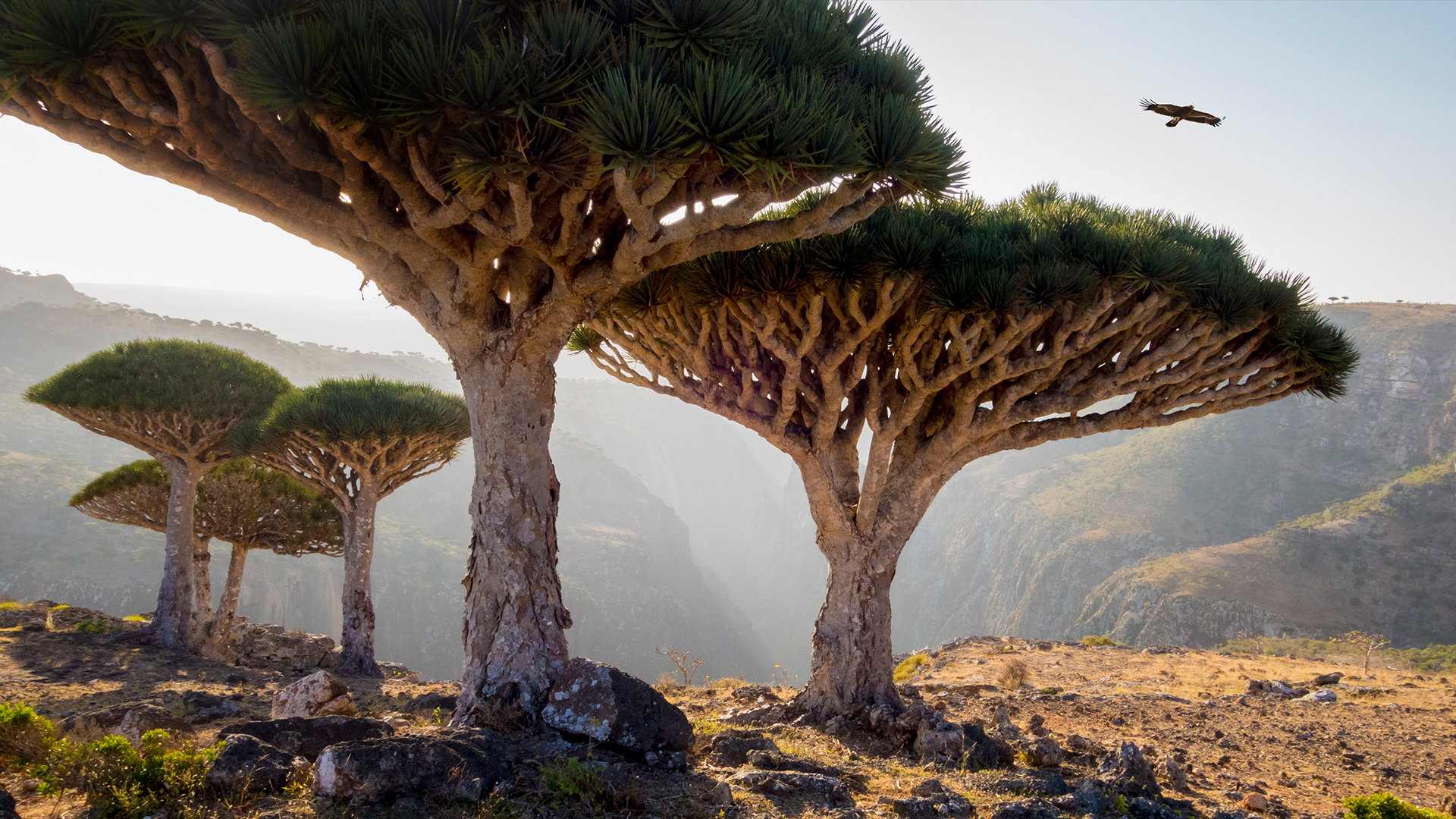
Socotra is an island in the Arabian Sea known for its unusual plants and isolated ecosystem.
One of its most recognizable trees is the dragon blood tree, which has a wide umbrella-shaped canopy. The tree produces a reddish resin that has been used historically for various purposes.
Socotra’s long geographic isolation allowed many species to evolve in distinctive ways. A significant number of its plants are found nowhere else in the world.
The strange appearance of its vegetation makes parts of the island look like a setting from a fantasy movie.
The Giant’s Causeway Looks Like an Alien Construction
Northern Ireland’s Giant’s Causeway contains thousands of closely packed basalt columns.
Many of the columns have six sides, creating an unusual geometric pattern along the coast.
The formations developed from volcanic activity. As molten rock cooled and contracted, it cracked into distinctive polygonal columns.
The precision of the shapes can make the landscape look artificially constructed. However, the remarkable geometry is a natural result of cooling volcanic rock.
The Richat Structure Looks Like a Giant Target
The Richat Structure in Mauritania is a huge circular geological formation in the Sahara Desert.
From the ground, its enormous size is difficult to appreciate. From above, however, it resembles a giant eye or target.
The structure was once thought by some observers to have been caused by an impact, but geological studies have linked its formation to uplift and erosion of layered rock.
Its circular pattern is one of the most unusual geological features visible from space.
The Wadi Rum Desert Looks Like Another Planet
Wadi Rum in Jordan is famous for its enormous sandstone mountains, red sand, narrow valleys, and dramatic rock formations.
The landscape has been shaped by wind and erosion over long periods, producing cliffs and natural arches across the desert.
Its reddish terrain and rugged appearance have made it a popular location for films depicting other planets.
Standing among its massive rocks, it is easy to understand why filmmakers have used the region to represent alien landscapes.
Earth Can Be Stranger Than Fiction
These extraordinary places show that Earth does not always look like the familiar world we see around our homes. Some landscapes resemble Mars, others look like enormous paintings, while some appear almost completely artificial.
Yet every one of these environments has a natural explanation. Geological activity, erosion, minerals, climate, and biological evolution have worked together to create landscapes that seem almost impossible.
The most remarkable part is that these places are not distant fictional worlds. They exist on our own planet.
Earth is still full of unusual environments waiting to be explored, photographed, and understood. Sometimes, the best way to appreciate how extraordinary our planet is simply to look at the places that seem least like Earth.